Retail ecommerce
October 30, 2026 · 9 min read
Your Next Walmart.com Customer May Be an Agent With a $100 Limit
Let me begin with a shopper who doesn’t exist. I’ll call her a magnesium buyer, because supplements are the kind of thing people run out of on a schedule. She takes the same one every night. Every two months or so she remembers, usually at ten p.m., that the bottle is empty.
Now give her a new option. She opens her AI assistant, ChatGPT or Gemini, and says: “Keep me stocked on the magnesium I like. Spend up to $100 without asking me.”
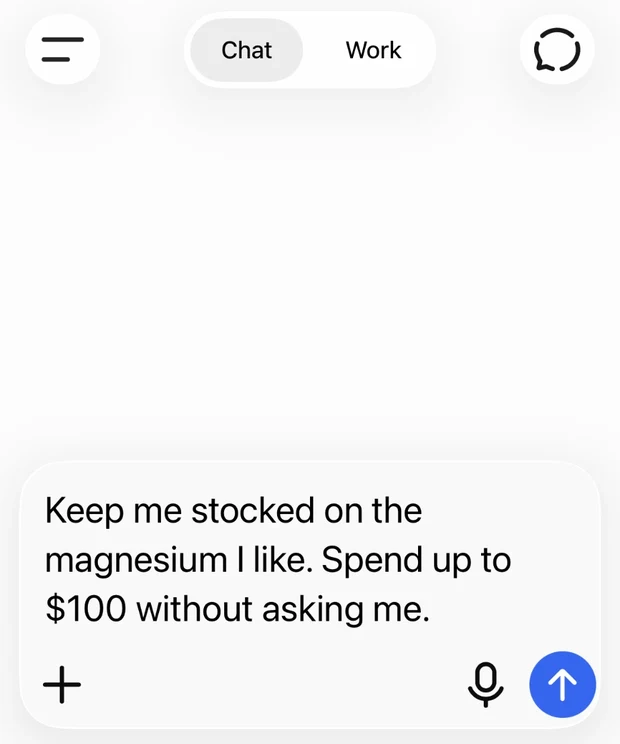
And that’s the end of her involvement. She doesn’t browse. She doesn’t read a single product page. Somewhere, an agent searches Walmart.com, compares what it finds, and buys.
This is no longer a thought experiment. On October 21, 2026, Walmart announced the mechanism for it [1]. The $100 comes from Walmart’s own examples (the others were $50 and $200), so it’s an illustration, not a standard. What matters is the structure. Below the limit, nobody is there to be persuaded.
I want to explain what Walmart announced, what it changes and doesn’t change for sellers and suppliers, and why I think the most important part of the story is the one most Walmart sellers haven’t tested yet.
The Walmart.com agent and the spending limit
Start with what was happening before. An AI agent that shopped Walmart signed in as the customer. Its orders landed in the customer’s account, mixed in with her own purchases [1]. There was no way to tell the human from the machine.
Walmart’s answer is to give each agent its own profile inside the shopper’s account. The shopper either approves every purchase, which is the default, or sets a limit and lets the agent buy inside it [1][3]. Walmart may still ask for extra approval even under the limit [1].
Think about which purchases survive that arrangement. Not the new sofa. Not the gift. The ones a person would be happy never to think about again. Walmart’s own example is a shopper’s usual bread and milk. Vitamins, pet food and paper goods have the same shape, and so does anything a customer buys on a schedule.
Here is why that matters. A human with a weak listing in front of her is still a human. She might be curious. She might read the reviews, or squint at the photo. An agent has no curiosity. If your item is missing a fact it needs, or contradicts itself, the agent doesn’t pause. It moves to the next item.
How it works
Walmart announced three pieces [1][5][6].
The first is Agent Profiles: a separate profile for each AI agent a shopper uses, with the agent’s orders shown apart from the customer’s own. Walmart said they arrive “in the next month,” which points to about November 2026, with no exact date.
The second is the Walmart Agent Gateway. It runs on MCP, the Model Context Protocol, a standard way for AI tools to talk to outside systems, so agents don’t have to click through pages designed for people. It is an invitation-only beta for companies and developers that build agents, according to Walmart’s beta page as reported by Eva [6].
The third is a set of terms. Agents may not act beyond what the shopper intended. They can’t see payment cards or change payment methods. They may use only the data the task needs. Walmart’s normal returns apply when an agent gets an order wrong, and agents that break the rules are blocked [1][3].
It covers Walmart.com and Sam’s Club. Agents see the same prices and fees a person sees, and Walmart+ is not required [1].
Three questions every seller asks
Do I have to build or enroll in anything? No seller step has been announced [1][6]. The shopper starts in the agent’s own app, and companies that build agents apply to the Gateway beta. What a brand controls is its listing data, because that is the only thing the agent can read.
Does it cost more? Walmart announced no fee and no seller ad product for outside agents [1]. Whatever the agent app costs is set by its maker.
Is this Sparky? No source says so. Sparky is Walmart’s own assistant. Outside agents are other companies’ assistants shopping Walmart directly. Both read the same catalog, which means that fixing the catalog serves both.
The retailer that chose differently
The same week offers a useful contrast. TechCrunch reported that Amazon blocks outside shopping agents, including Meta’s and Perplexity’s, even as Walmart rolled out a welcome [2]. Amazon’s route to the shopper runs through its own assistant. At unBoxed 2026 it announced Branded Conversations, placements inside Alexa for Shopping [7].
So two companies looked at the same technology and reached opposite conclusions. Walmart opened the door and let the product data decide. Amazon kept the shopper inside its own assistant and began selling placement there. For a brand on both, the work is different on each side.
What the agent actually reads
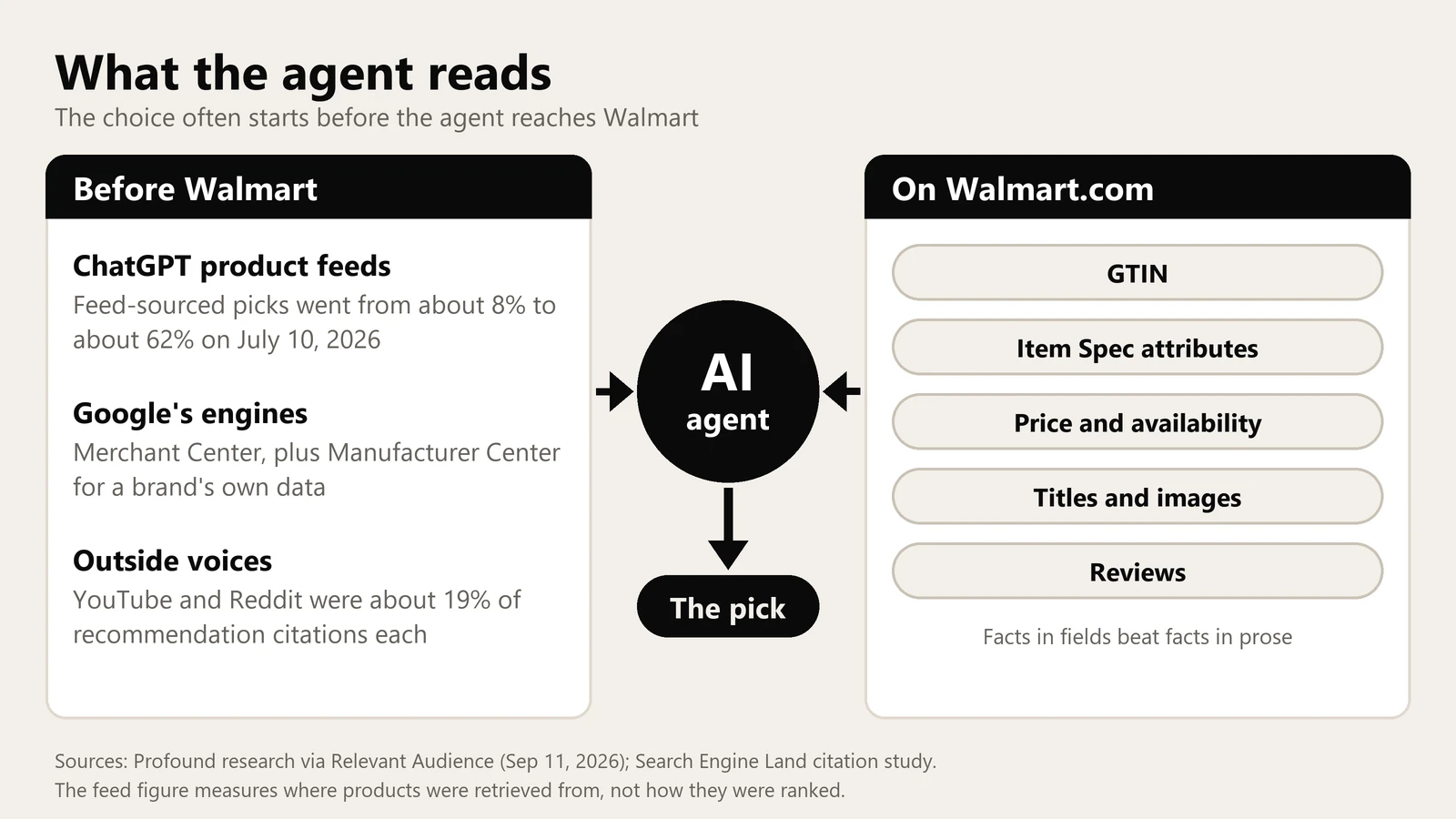
On Walmart, the answer is simple. The agent reads your listing: the title, the attributes, the images, the price, the availability and the reviews. Facts in structured fields are easy for an agent to use. Facts buried in a paragraph of marketing copy are easy to miss.
But consider where the choice begins. Often it begins before the agent ever reaches Walmart. A few findings are worth sitting with:
- Profound analyzed 1.76 million ChatGPT Shopping prompt runs and found that the share of picks sourced from merchant feeds jumped from about 8% to about 62% on July 10, 2026, reaching about 65% by early September [8]. That research measured where products were retrieved from, not how they were ranked, and OpenAI has not confirmed the change. It is a strong signal from one vendor.
- Vendor guidance on ChatGPT shopping points to availability, price, quality and whether the seller is the maker or primary seller [9]. This is advice from a vendor, not a statement from OpenAI.
- Google’s engines read Merchant Center, and Manufacturer Center is a free way for a brand to supply its own product data [13]. At NRF 2026, Sundar Pichai described Google’s Universal Cart, built with Walmart among others [12].
- Answer engines lean heavily on outside voices. One citation study reported by Search Engine Land found YouTube and Reddit each at about 19% of recommendation citations, ahead of brand pages [11].
Being findable and choosable by AI, beyond simply ranking in search, is what people have started calling GEO, for generative engine optimization.
I ran a small test of my own. I put 20 shopper questions to Sparky in two passes. About 7 in 10 of its picks sat in Walmart’s organic top 10 for the matching search. Old search rank still matters. But this is an early test with a small sample, and I would repeat it before leaning on it.
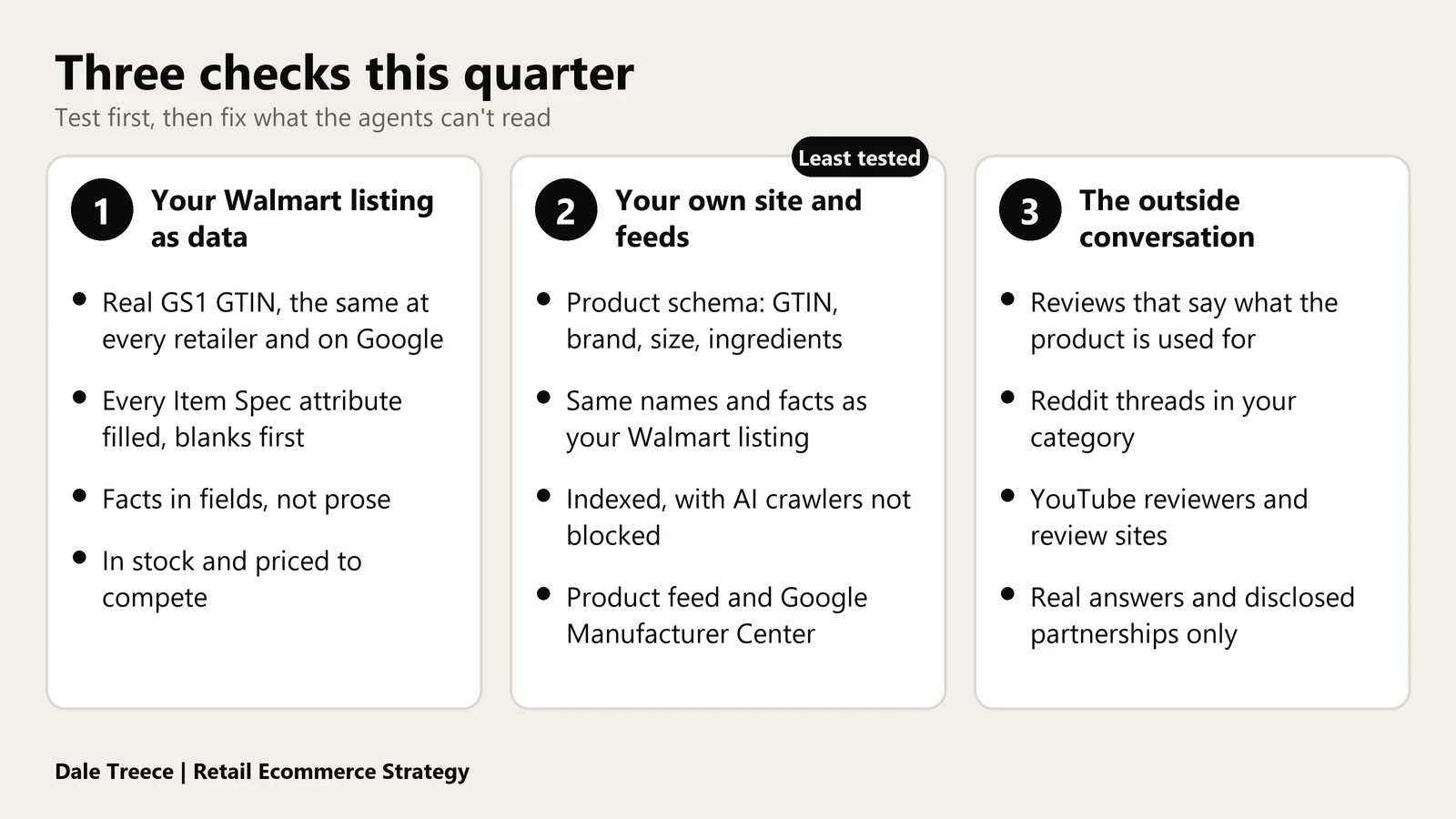
Three checks to run this quarter
First, your Walmart listing, treated as data. Confirm every item carries a real GS1 GTIN, the same one at every retailer and on Google, because that is how engines match your item across sellers. Fill every required and recommended Item Spec attribute, blanks first. Move facts such as servings, pack count, dietary claims and dimensions out of prose and into fields. Keep items in stock and priced to compete, since agents filter on availability and price before they read a word of copy. Walmart’s October release notes list two new free tools for this work: Brand Highlights (October 19) and Search themes (October 21) [13].
Second, your own site and feeds. For a DTC or 3P brand, this is the one source that speaks only for you. Give each product its own page with Product schema covering GTIN, brand, size and ingredients, the same names and facts as Walmart, indexed in Google and Bing, with AI crawlers not blocked by accident. Submit a product feed where the engines accept one, and register with Google Manufacturer Center [14]. When your site and your listing contradict each other, every engine that compares them trusts you a little less.
I should be careful about what I’m claiming here. On Walmart.com, the agent reads Walmart’s catalog, and for brands sold mainly through retailers, ChatGPT sees them largely through retailer data. My claim is narrower. Your own site and feeds matter more than they did, and they are the piece most Walmart sellers have not tested.
Third, the outside conversation. Reviews, and the third-party sources AI cites in your category: Reddit threads, YouTube reviewers, review sites. Disclosed partnerships and real answers only.
How would you know where you stand?
There’s a puzzle at the center of all this. Most brands are being asked a question they cannot answer: are we showing up in AI? The usual response is a guess.
I ran this kind of test on a supplement brand. Across 52 written answers from AI tools, the brand was not named once. That told us more about what to fix than any rank report did.
The method is simple. Ask real shopper questions for your category in each AI tool, several times each, because the answers vary. Record who shows up, why the tool says it chose them, which sources it cites, and where the link goes. Add a check of your website. The tool is the thermometer, not the medicine. What you get back is a list of what to fix first.
If you want it tested
I have 30+ years in retail marketing, including time inside Walmart, and I founded and sold a digital-shelf analytics company. If you want to know whether the agents can find and choose your products, on Walmart.com and on your own site, I’ll test it and show you what to fix first. Shoot me an email at dale@daletreece.com or you can book a call here.
I’ll give you a clear read on where your Walmart, Amazon and website sales are leaking, and a prioritized plan, with briefs, to fix it.
Dale Treece | Retail Ecommerce Strategy
Sources
- Walmart: Making It Possible for Agents to Shop on Behalf of Customers (Oct 21, 2026)
- TechCrunch: While Amazon blocks AI agents, Walmart rolls out the welcome mat (Oct 21, 2026)
- Retail Dive: Walmart welcomes external AI shopping agents (Oct 22, 2026)
- The Next Web: Walmart will let AI agents shop for you (Oct 23, 2026)
- Eva: What Walmart Agent Gateway means for sellers (vendor, Oct 22, 2026)
- Amazon Ads: unBoxed 2026 announcements
- Relevant Audience: ChatGPT shopping leans on product feeds (Profound research) (Sep 11, 2026)
- Alhena: ChatGPT shopping optimization (vendor)
- Search Engine Land: AI search engines cite Reddit, YouTube and LinkedIn most
- Google: Sundar Pichai at NRF 2026 (Jan 2026)
- Walmart Marketplace release notes (Oct 19 and 21, 2026)
- Google: Manufacturer Center